
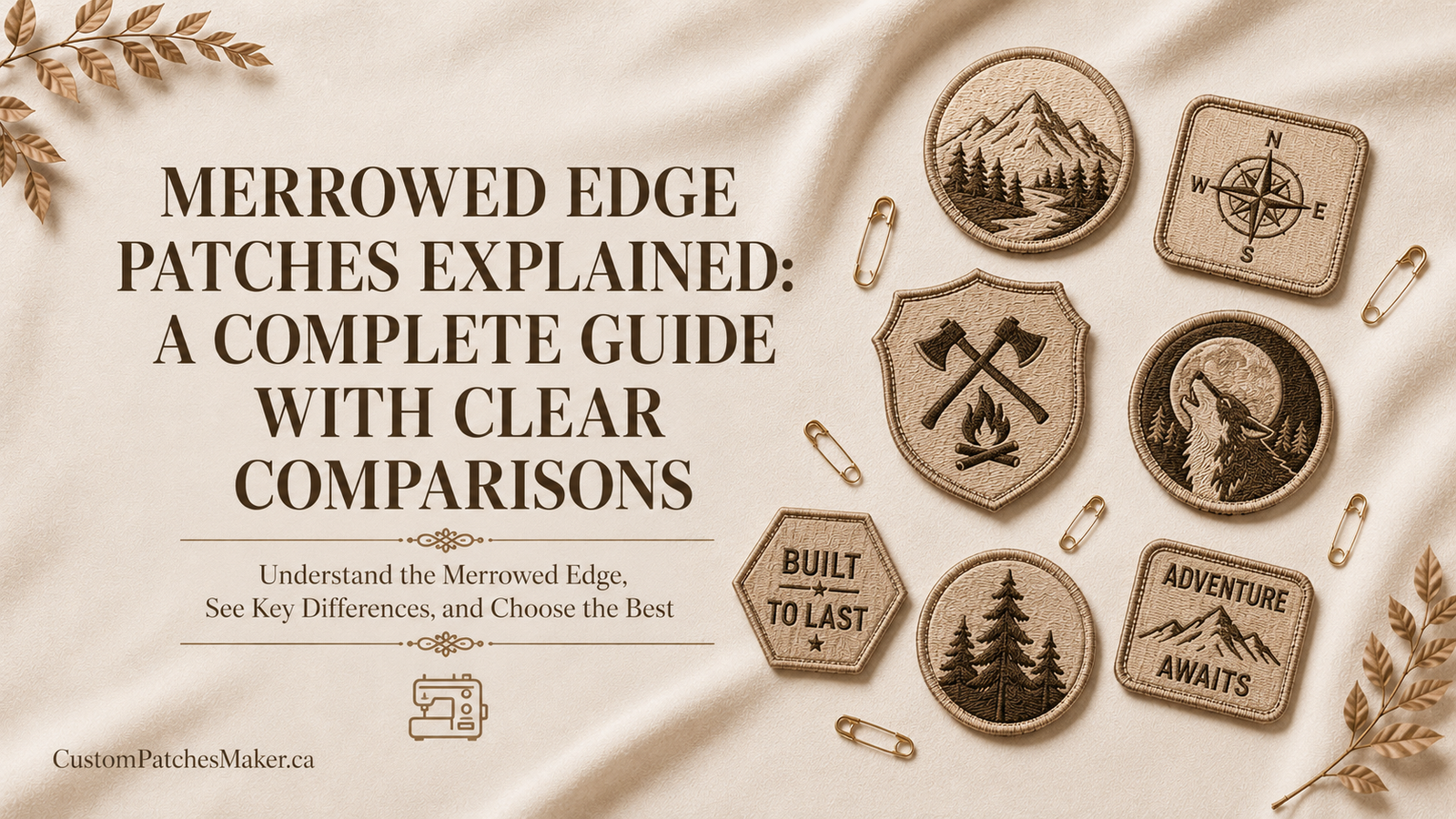
Sometimes it becomes a headache while choosing the right edge type for patches. Despite this, most people in Canada prefer meadow edges for the paths. Today, we will talk about what merrowed edges are for badges and compare them with embroidered and heat-cut borders.
However, if you want a one-word answer, which one is better in all of these edges, we will recommend choosing merrowed edge patches.
Before we compare merrowed edge patches to embroidered and heat-cut edges, let’s learn about what precisely a merrowed edge is.
What Is a Merrowed Edge?
Likewise, a merrowed edge is actually a thick stitched border for the patches, which holds the corners of the patch to make them last longer. Merrowed edge is created by wrapping the patch edges tightly around the outside. That’s why it’s also known as overlocking the stitches because it completely covers the raw fabric edges.
The benefit of using merrowed edge for the patches it locks the threads and avoids peeling and fraying. Also, this method helps you achieve that 3D effect and high raised finishing in embroidered patches. Merrowed edge overlocks the borders, providing security with awesome designs in the border.
Now it’s time to compare both merrowed edge patches to heat cut borders.
Merrowed Edge vs Heat-Cut Edge
Merrowed and heat-cut edges are two different types of stitching for the patch borders. Each type is helpful for its own specialties. Some people prefer merrowed edges, and others like cutting the edges using heat. In heat cut edges, the heat is used to cut the border of the patches, which eventually seals the fabric. The benefit of using heat heat-cut edge is that it gives a smooth and thin outline, but not very significant in providing safety.
Comparison Table: Merrowed vs Heat-Cut Edges
| Feature | Merrowed Edge | Heat-Cut Edge |
| Edge Thickness | Thick, raised, stitched border | Thin, flat, sealed edge |
| Durability | Very high, resists fraying | Moderate, may wear over time |
| Best Shapes | Simple shapes like circles and squares | Complex or irregular shapes |
| Look & Style | Classic, bold, professional | Modern, seamless, minimal |
| Best For | Uniforms, sports, everyday wear | Artistic designs, logos, fine details |
| Feature | Merrowed Edge | Heat-Cut Edge |
| Edge Thickness | Thick, raised, stitched border | Thin, flat, sealed edge |
You get more safety for your patch edges with merrowed edges because it uses strong thread to overlock the corners. Meanwhile, heat edges are trimmed with heat and do not promise permanent locking.
Heat-cut edges are trimmed with heat, giving a flat and thin finish. They are better for very detailed or oddly shaped patches, but may wear out faster over time. If you regularly wash the patches, merrowed edges ensure they last longer, while heat-cut borders might give you a tough time. Despite the heat, cut edges look good when you have sharp patch edges.
However, now let’s compare both merrowed borders with embroidered edges for the patches.
Merrowed Edge vs Embroidered Border
Another stitching for the patch border is using embroidery. An embroidered border is stitched right into the patch design itself instead of wrapping around the edges. You cannot tell if there is a different border made for your patches because embroidered patches merge into the design very easily.
Comparison Table: Merrowed vs Embroidered Borders
| Feature | Merrowed Edge | Embroidered Border |
| Stitch Placement | Wrapped around the outer edge | Sewn flat into the design |
| Shape Flexibility | Limited to simple shapes | Works with complex shapes |
| Durability | Very high | Moderate |
| Visual Effect | Bold, raised frame | Smooth, blended finish |
| Best Use | Workwear, uniforms, backpacks | Detailed logos and custom shapes |
You can clearly see and feel the merrowed edges outside the patch borders, acting like armor and protecting the whole badge. On the other hand, embroidered borders blend into the design and are stitched flat with no unique patterns. If you prefer high raised and solid edges for your patches, you should choose merrowed borders. Meanwhile, if you don’t really need safety and prefer perfect designs, then you can go with embroidered borders.
Best Patch Shapes for Merrowed Edges
If the patch shapes are simple and not so many curves and sharp edges, then merrowed edges work best for these patch shapes. Meanwhile, it does get tricky when shapes are complex because the thread should move smoothly without sharp turns. Here are a few shapes of patches we will recommend if you want merrowed-edge patches:
- Circles and ovals allow the thread to wrap evenly, creating a clean and professional finish.
- Squares and rectangles look sharp and balanced with merrowed borders, especially for name or logo patches.
- Rounded shapes help the stitching flow naturally without bunching or gaps.
Shapes to Avoid
Here are the patch shapes you should avoid while choosing the merrowed edge patches:
- Sharp points like stars can cause uneven stitching.
- Flame or jagged designs may weaken the edge over time.
- Very detailed cut-outs usually look better with heat-cut or embroidered borders.
Patch Types That Work Best with Merrowed Edges
This is really important to know if you want merrowed edge patches, then you have to be sure while choosing the correct type of patch. Because merroed borders do not work well for all the types of patches. However, here are the types of patches that are safe to merge on:
- Embroidered patches benefit the most because the raised threads pair well with a strong stitched border.
- Chenille patches look bolder and cleaner when framed with a merrowed edge.
- Woven patches stay neat and don’t fray when finished with merrowing.
Patch Types That Don’t Need Merrowed Edges
Likewise, you should avoid these few types of patches in case you want merrowed edges for your patches:
- PVC patches don’t fray, so stitching isn’t necessary.
- Leather patches can be damaged by overlock stitching.
- Sublimated patches usually look better with flat, cut edges.
Why Choose Merrowed Edge Patches?
Usually, people get confused about choosing the right edges for their patches. So they ask why they should choose the merrowed edge patches. However, if you want the simplicity, class style and durability in your patches, then merrowed edges should be your first choice. However, here are the reasons you should merrowed patch edges:
- They protect the patch from fraying, even after repeated washing.
- The raised border gives a classic, professional look that stands out.
- They are cost-effective for bulk orders and everyday use.
- Ideal for uniforms, clubs, sports teams, and workwear.
Final Thoughts
Merrowed edge patches are the most reliable and safe choice for anyone who prefers durability, comfort, and raised designs in the borders. Also, we recommended different types of patches and the ideal shapes for perfect merrowing edges.
If you are looking for high-quality custom patches in Canada, then look no further. CustomPatchesMaker.ca is offering the best badges with a wide range of types, such as PVC, leather, embroidered and many more.